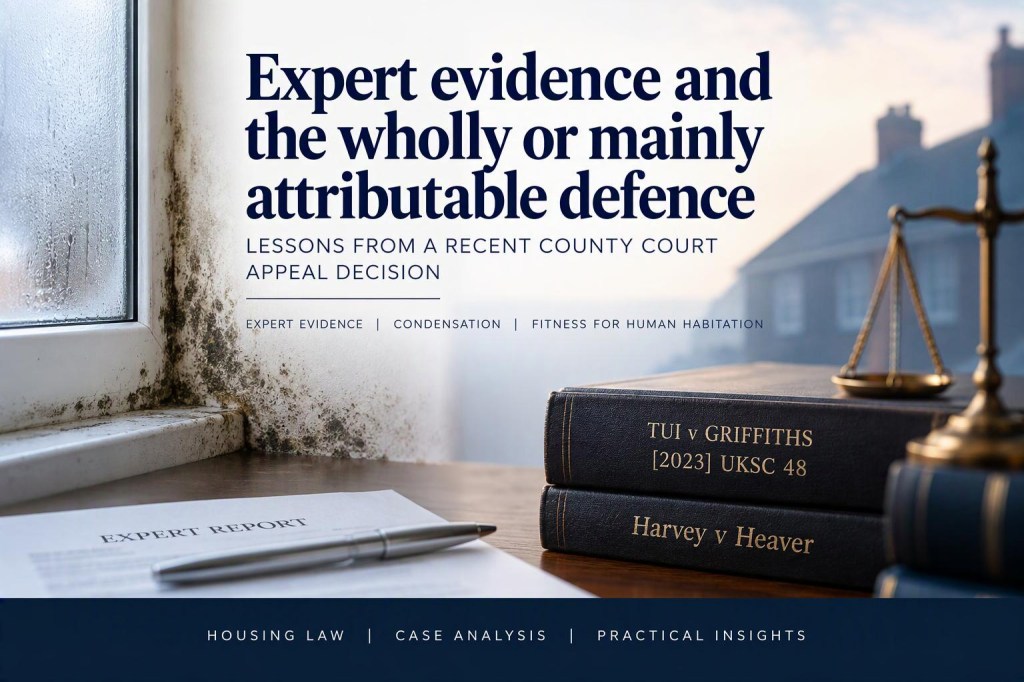
We have another helpful County Court appeal decision to seek our teeth into. This one concerns the treatment of expert evidence and the ‘wholly or mainly attributable’ [to the conduct of the tenant] defence. The case can be found here: https://www.bailii.org/ew/cases/Misc/2026/CC59.html
I am grateful to Gordon Exall for sharing this on his blog with an excellent analysis of the procedural rules: https://www.civillitigationbrief.com/2026/11/06/expert-watch-84-the-trial-judges-approach-to-the-expert-evidence-was-wrong-the-approach-in-tui-had-to-be-considered-an-important-decision-for-housing-lawyers/
The decision can also be seen as a natural application of Harvey, which I write about here: https://thelegalposition.co.uk/2026/07/07/harvey-v-heaver-much-welcome-clarification-on-s-9a-lta-1985/
The case
The salient points are as follows:
a. There was a single joint expert (‘the SJE’) report, and Part 35 questions were asked and responded to.
b. The SJE did not identify actionable structural disrepair. Instead, the mould was caused by condensation. Thermal bridging and deficiencies in insulation were significant contributing factors to the development of condensation and mould growth.
c. In the Part 35 responses, the SJE rejected the proposition that the recurring mould could be attributed principally to matters such as indoor clothes drying, ordinary domestic occupation or failures of ventilation.
d. The first-instance DDJ decided that there were no structural issues and the works proposed by the SJE were improvements.
e. In respect of fitness for human habitation, she found that the Property was unfit but found in favour of the Defendant because, causally, the mould was caused at least in part by the drying of clothes in the Property and the lack of ventilation.
f. The claim was therefore dismissed.
A number of interesting points arise from this. The first is the treatment of expert evidence.
Expert evidence
The primary authority here is Tui v Griffiths [2023] UKSC 48 (https://supremecourt.uk/uploads/uksc_2021_0208_judgment_2a7059e7f8.pdf).
Paragraphs 102-131 set out, in detail, the Court’s position in respect of this. In summary, it is not the case that unchallenged expert evidence must be accepted. A Judge is free to reject expert evidence, but an explanation is needed to show why the expert’s reasoning has been displaced.
It is right that uncontroverted expert evidence may not be accepted, for example where the evidence is internally inconsistent, plainly contrary to established facts, founded upon assumptions shown to be incorrect, speculative, inadequately reasoned, or otherwise lacking in evidential reliability.
Likewise, and importantly, where findings of primary fact (by the Court) undermine assumptions essential to an expert’s reasoning, a Court may properly conclude that the opinion no longer carries persuasive weight.
If a party contends that an expert’s assumptions are wrong, those assumptions must be identified. If an expert’s reasoning is defective, the deficiency should be exposed. If the court ultimately departs from that evidence, the judgment must explain why.
The Part 35 questions were important: the significance of Part 35 questions lies not merely in the answers obtained but in the issues they identify. They provide a mechanism by which an opposing party may expose flaws, challenge assumptions and test reasoning without incurring the cost of instructing another expert.
Applying this to housing disrepair cases concerning overlapping causation issues in respect of condensation, the Court is entitled to make factual findings as to the manner in which the Property is occupied. The DDJ in this case did exactly this.
What she failed to do thereafter was undertake the next stage of the reasoning (I make no criticism of the DDJ – it must be very difficult picking up a complex disrepair case as a judge, especially if the DDJ does not practice in housing law).
The DDJ was nonetheless required to explain why those findings required rejection of the expert analysis. This was especially so in this case when the expert had already considered issues of ventilation and occupation. This step also links to the points raised below in respect of the ‘wholly or mainly’ defence, in that there was no analysis explaining why indoor clothes drying displaced the SJE’s conclusions concerning thermal bridging.
The ‘wholly or mainly’ defence
Firstly, the Court acknowledged that a difference between repair obligations and fitness for human habitation obligations is that the principle of ‘improvements’ does not apply to the latter. Indeed, it held at [88] ‘In such circumstances, concentration upon the language of repairs and improvements risks obscuring the true statutory inquiry’ and at [90] ‘A court addressing a fitness claim must therefore be careful not to permit concepts associated with disrepair to dominate the analysis. Whether proposed remedial works amount to repairs or improvements may be relevant to the resolution of a disrepair claim. It is not determinative of a claim under [fitness for human habitation]. The statutory question is whether the dwelling is fit for human habitation. The answer to that question may be “no” even where the works required to resolve the problem might properly be described as improvements. Accordingly, whilst repairing obligations and fitness obligations may overlap, they are not co-extensive.’
This position reflects Harvey, as confirmed at [94].
Against that backdrop, the ‘wholly or mainly’ defence contained within statute is important. As the Court held at [95]: ‘The section does not refer merely to contribution. It does not ask whether the conduct of the contract-holder played some role in causing the relevant condition. Nor does it ask whether the conduct was one of several competing causes. Instead, the legislature chose the words “wholly or mainly”. Read according to their ordinary meaning, those words import a test of predominance. The landlord is exonerated only where the condition arises entirely because of the conduct in question or where that conduct constitutes the principal or dominant cause of the relevant unfitness. The statutory threshold is therefore a significant one.’
Paragraph [96] sums up the position perfectly: ‘The section consequently requires a causal analysis. A court must first identify the condition rendering the dwelling unfit. It must then identify the cause or causes of that condition. Finally, it must determine whether acts or omissions of the contract holder are properly to be regarded as the whole or principal cause. That exercise may be straightforward in some cases. In others, particularly where mould and condensation are concerned, it may be considerably more complex because multiple causes frequently coexist. Condensation is rarely attributable to a single factor. It may arise from interactions between ventilation, insulation, humidity, thermal performance and patterns of occupation. In such cases, a court must resist the temptation to treat the identification of a potential contributing factor as equivalent to proof of predominant causation.’
The Court gave some examples of what may be outside the range of ordinary domestic use. These include persistent obstruction of ventilation systems, refusal to use provided facilities, generation of exceptional levels of humidity, or patterns of occupation significantly beyond ordinary expectations.
This distinction between ordinary domestic occupation and conduct which materially exceeds what may reasonably be expected is important. It also reinforces what we already know from Harvey.


Leave a Reply