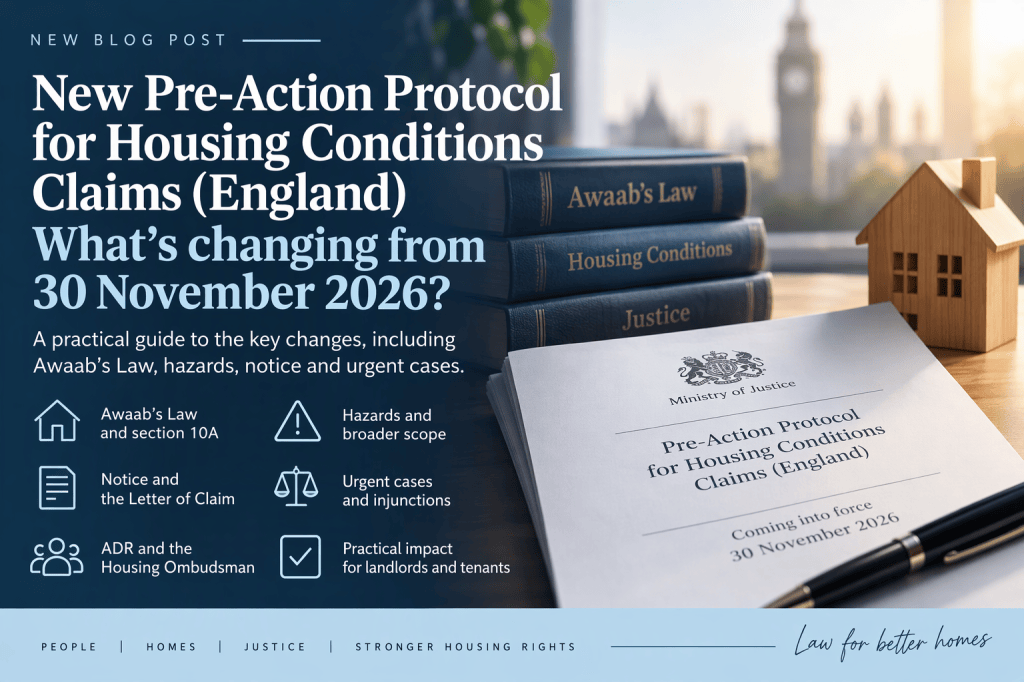
The Pre-Action Protocol for Housing Conditions Claims (England) (‘the Protocol’) will be change on the 30th November 2026. The timing is significant. Phase 1 of Awaab’s Law came into force on 27 October 2025, while Phase 2 will come into force on the same date as the revised Protocol and extend the regime to a wider range of significant hazards.
The current version of the Protocol can be found here: https://www.justice.gov.uk/courts/procedure-rules/civil/protocol/prot_hou
The revised version of the Protocol can be found here:
https://www.justice.gov.uk/documents/housing-conditions-pap-update.pdf
So, what has changed? The table below is a summary of the key changes and I analyse some further points below the table.
| Issue | Current / old protocol | New protocol from 30 November 2026 | Practical significance |
| Overall scope | Applies to claims concerning “poor housing conditions”. | Expressly extends the wording to claims concerning poor housing conditions “including the existence, or possible existence, of hazards” and expressly mentions claims under ss.9A and 10A LTA 1985. | The PAP is now expressly framed around hazards, not simply conventional disrepair/fitness claims. |
| Awaab’s Law / s.10A | No reference, understandably, to s.10A. The protocol specifically refers to s.9A and s.11 LTA 1985. | Expressly includes s.10A LTA 1985and the Housing (Prescribed Requirements) (England) Regulations 2025, presently applicable to social landlords. | Probably the most important substantive change. The PAP now expressly caters for Awaab’s Law claims. |
| What counts as a housing conditions claim | A civil claim “arising from the condition of residential premises”. | Broadened to one “arising from or relating to” the condition of premises, expressly including the existence or possible existence of a hazard which affects, or may affect, the premises. | Deliberately broader language, particularly important where the alleged hazard has not yet produced traditional actionable disrepair. |
| Notice before PAP | Tenant should ensure the landlord is aware of the conditions before using the PAP. | Expressly explains that notifying the landlord may be a pre-condition to legal liability, and importantly states that the Letter of Claim may itself constitute notification. | Important for notice arguments. A landlord cannot necessarily say there was no notice merely because there was no earlier repair report. The LoC itself may supply notice, although liability/timing consequences still depend upon the particular cause of action. |
| Unresolved damages | Refers generally to poor conditions remaining unresolved. | Expressly says unresolved matters include “any questions as to damages”. | Confirms the PAP can remain relevant after works have been completed where damages remain disputed. |
| Urgency / dispensing with compliance | Recognises urgency in particular contexts, including sending an early notification and pursuing separate housing and PI claims. | New para 1.6 expressly recognises that full or partial PAP compliance may not be appropriate where there is serious risk to health/welfare without urgent court intervention, or where PAP compliance would subvert mandatory statutory/regulatory deadlines. | Major practical change.Particularly relevant to emergency hazard/Awaab’s Law cases. PAP compliance cannot be used to frustrate urgent proceedings. |
| Landlord’s substantive duties during PAP | No equivalent express statement in the introductory provisions. | New para 1.7 expressly says the protocol does not affect the coming into existence or continuation of liability, and is not a reason or excuse for a landlord to delay performance of a legal duty. | Very important for defendants.Receipt of a PAP letter does not pause the repair/hazard response clock. The PAP and the statutory duty run alongside one another. |
| Specific performance | Says PAP applies whatever the value of the damages claim. | Applies whatever the value of any damages or specific performance claim, although expressly subject to the urgent-case provisions in 1.6 and 1.7. | Expressly captures injunction/specific-performance relief. |
| Aims: resolution | Aim stated as avoiding unnecessary litigation. | Recast as enabling the parties to resolve matters without needing to start proceedings, including through ADR. | Greater express emphasis on ADR. |
| Aims: information and advice | No separate equivalent aim. | New aim that tenants receive “any information or advice to which they are entitled” as speedily as possible. | This reflects the new information obligations associated with the 2025 Regulations. |
| Expert evidence | Aim is to provide guidance about the instruction of experts. | Aim is recast as guidance on expert evidence “to ensure it is restricted to that which is reasonably required”. | Greater emphasis on proportionality and necessity, rather than assuming an expert needs to be instructed. |
| ADR and the court’s powers | Parties should consider ADR; the court may require evidence that ADR was considered. | Adds expressly that ADR can be used at any stage of the PAP and, once litigation starts, the court can order the parties to engage in ADR. | Reflects the modern CPR position on compulsory ADR. |
| Social housing complaints procedure | Lists the council/landlord’s complaint or arbitration procedure. | Specifically says landlord complaints procedures should adhere to the Housing Ombudsman’s Complaint Handling Code. | Ombudsman compliance becomes much more prominent in the PAP framework. |
| Housing Ombudsman and litigation/PAP | Housing Ombudsman simply identified as an available route for social housing conditions complaints. | Expressly states that, where within its rules, the Ombudsman can progress a complaint at the same time as the parties follow the PAP. | Removes any suggestion that the tenant necessarily has to choose between PAP and Ombudsman procedures. |
| Early notification of claim | Early notification may be appropriate because detailed information cannot always be obtained quickly and particularly where matters are urgent. | Adds the important explanation that many landlord duties may only arise once there is notice of the underlying matter, so the object is early notification both of the underlying problem and the claim. | Again, elevates notice and the point at which statutory duties are triggered. |
| Letter of Claim: defects/hazards | Requires details of “defects”. | Expressly states that “defects” includes hazards. | LoCs should now clearly plead identified or suspected hazards rather than simply listing items of disrepair. |
| New s.10A Letter of Claim | No equivalent. | Annex A expressly contains a template relating to claims by tenants under the covenants implied by s.10A LTA 1985 for breach of the 2025 Regulations. | Significant drafting change for claimant solicitors and social landlords responding to PAP letters. |
| Personal injury | Minor PI evidenced only by a GP letter can remain within the housing PAP; otherwise PI PAP applies. | The same basic approach is retained. | No major substantive alteration apparent here. |
| Counterclaims/set-offs | Housing-condition counterclaims/set-offs arising in other proceedings are outside the PAP, although parties are expected to exchange information and attempt settlement. | Same basic exclusion retained. | Housing disrepair counterclaims in possession proceedings therefore remain outside the PAP itself. |
The new Protocol is significantly more up to date. In my view, the changes are fair and also spell out some pretty basic issues which are routinely seen in pleadings. For example, it is commonplace for Defendants to plead, wrongly, that a compliant letter of claim does not have the effect of putting the Defendant on notice. This is and always has been a bizarre argument that does not stand up to scrutiny, and the new paragraph 1.4 erases any doubt.
The express inclusion of hazards within the Letter of Claim requirements should assist landlords in identifying the case they must investigate and answer. However, the revised Protocol does not appear to require a claimant to assign a formal HHSRS category to every alleged hazard. This is in keeping with the Guidance to the 2025 Regulations.
Paragraph 7.5 of the Protocol specifically addresses interim injunctions and significant risk to the health and safety of the occupiers of a property.
Paragraph 1.6 is also likely to be important in urgent injunction claims. It expressly recognises that full or partial compliance with the Protocol may not be appropriate where urgent court intervention is required to address a serious risk to health or welfare, or where compliance would undermine a mandatory statutory deadline. This should make it considerably more difficult to resist an otherwise properly brought urgent application merely because every step under the Protocol has not first been completed.
Paragraph 1.7 is also significant. It is often argued that the ‘clock’ stops once a letter of claim has been received and the expert evidence has crystallised. Paragraph 1.7 puts an end to this argument. However, it is often the case that the letter of claim says works are not to be done until after the experts have inspected the property: a position such as this would likely be seen as the Claimant refusing to allow the Defendant to complete works. The better position would be for the Claimant to say something along the lines of: if you are going to carry out works then please provide a full schedule of the works and provide photographs both before and after the works have been completed.
Landlords will need to check carefully whether their internal complaints procedure adheres to the Housing Ombudsman’s Complaint Handling Code. Arguments for not using an internal complaints policy spiked around 18 months ago but then died soon after. I cannot see the new requirements changing much. If the Defendant raises it as an issue, there may be a lot of satellite litigation as to whether the complaints procedure complies with the code or not. This will simply escalate costs.
Moving forward, we of course have Awaab’s Law phase 2 which I will be writing about soon. It is yet to be seen whether Housing Conditions claims will be subject to fixed costs and whether the £1,000 limit for fast-track allocation will remain as it is. I have already seen significantly more Awaab’s law injunctions be issued in my own practice, I suspect the number of these injunctions will continue to increase moving forward. For practitioners, that likely means more interim injunctions, yet fewer trials.


Leave a Reply