I’ve neglected the blogging of late, and I intend to right that wrong moving forward. This article covers the somewhat novel and topical issue of injunctions under Awaab’s Law, formally known as The Hazards in Social Housing (Prescribed Requirements) (England) Regulations 2025 (‘the 2025 Regulations’).
I am aware that a handful of these injunctions have been made, primarily it would seem in Courts down south, but I appeared at my first hearing yesterday. This article will explore some of the key points explored in the case and will set out some tips towards the end.
The case
I was instructed by Antony Hodari solicitors who had done an excellent job in bringing the injunction and dealing with the plethora of issues raised by the Defendant. My instructing solicitor, Rebecca Le Fondre, in particular displayed a high-level of analysis and tenacity in addressing each and every point raised by the Defendant. My opponent was a very experienced housing barrister with decades of experience. He was a formidable opponent and, I hope he doesn’t mind my saying, a gentleman. The Judge was a full-time experienced DJ who, like all great DJs, was able to understand the complexities of the law and the facts almost instantaneously. It always amazes me how Judges do this. 10 hours of preparation for me is condensed to mere seconds for a good Judge.
With that scene set, let’s move onto the case itself. The Claimant is pregnant with a young child. Her complaints relate to damp and mould in her child’s bedroom caused by a leak from the bathroom. The effects on her are drastic, as the damp and mould had spread to the child’s cot, mattress, carrier, and wardrobe.
In terms of key events:
- The Defendant had inspected the Property the day after the 2025 Regulations had come into effect. This inspection found a leak and damp and mould to the child’s bedroom.
- They completed a mould wash the day after this inspection. I should pause to say that this is exactly what the Defendant should have done. However, the Defendant did not complete or schedule any works in respect of the leak.
- Unsurprisingly, the Claimant continued to complain.
- The Defendant completed another inspection in March and found dampness to the child’s bedroom, in particular the water ingress was to an area where there was a plug socket.
- The Claimant’s expert inspected the Property in April and found the same issues.
- The Defendant’s Part 35 expert inspected the Property and found the same issues.
Following this, there were some attempts to complete works to the plug socket, but this largely involved workmen turning up at the Property unannounced with no notice given to the Claimant. The Defendant referred to SMS messages but had not produced any in the several statements that they had filed and served in response to the application.
I produced a detailed skeleton argument but also included the following documents which were extremely helpful:
I had highlighted only the relevant paragraphs in the version that I sent to the Court.
Before the hearing
The hearing was only listed for 15 minutes which I found deeply frustrating as in reality I was turning up to ask for directions for a longer hearing in the future. Mercifully, the Court changed the timetable to a 2-hour hearing the day before.
It is my practice to file and serve the skeleton argument as soon as possible. Some counsel take pride in ambushing their opponents at the last second with a skeleton argument. This is so the recipient has less time with their client in conference and is also an attempt to shake them up a bit. I do not subscribe to this practice. In my view, it is not what the Bar is about.
However, sometimes the consequence of trying to be fair and transparent by filing and serving a skeleton argument early is that the other side can try and take advantage of your good will. In my skeleton, I had highlighted the lack of evidence in respect of the Defendant’s allegations of a lack of access and the reasonable notice that they must give. The skeleton was served the day before the hearing.
The Defendant then, 45 minutes before the hearing, filed and served an additional statement attempting to address the criticisms I had raised in my skeleton argument. This was in my view unreasonable conduct. Their counsel also handed me a paper copy of the same, indicating that he had time to print it before heading to Court meaning that the statement was ready well before 45 minutes before the hearing. This behaviour is not acceptable, and it backfired, as will become clear.
The hearing
As you will expect, the Court dealt with the preliminary application for the Defendant to rely on the additional statement. The Court allowed this as there was only really one additional point raised since their other statement filed and served just three days earlier.
I invited the Court to deal with the case on a point-by-point basis. The Court agreed that it was sensible.
1. Do the 2025 Regulations apply?
The Defendant agreed that they did.
2. Do the hazards in the Property amount to ‘significant’ or ‘emergency’ hazards?
It is useful at this point to remind readers of the difference:
Regulation 3:
(1) In these Regulations—
(a) “significant hazard” means, in relation to a social home, a relevant hazard that poses a significant risk of harm to the health or safety of an occupier of the social home;
(b) “significant risk of harm” means a risk of harm to the occupier’s health or safety that a reasonable lessor with the relevant knowledge would take steps to make safe as a matter of urgency (but not within 24 hours);
(c) “emergency hazard” means, in relation to a social home, a relevant hazard that poses an imminent and significant risk of harm to the health or safety of an occupier of the social home;
(d) “imminent and significant risk of harm” means a risk of harm to the occupier’s health or safety that a reasonable lessor with the relevant knowledge would take steps to make safe within 24 hours.
…
“Relevant knowledge” means the knowledge that the lessor of the social home has, or reasonably ought to have, about the health and circumstances of the occupier.
The Defendant disagreed that the hazards in the Property reached the above thresholds. I took the Court through the various reports as detailed above, statement from the Claimant explaining the impact on her and her child, and the photographs of the mould-ridden cot.
The Defendant took a very curious approach to this point. They indicated that as a HHSRS assessment had not been completed. I responded referencing the persuasive authority of Red Kite and this gov guidance: https://www.gov.uk/government/publications/homes-fitness-for-human-habitation-act-2018/guide-for-landlords-homes-fitness-for-human-habitation-act-2018
Whilst the above refers to unfitness for human habitation, it must equally apply to the 2025 Regulations. I made the submission that a HHSRS assessment is not needed and whether the Property has a ‘significant’ or ‘emergency’ hazard is a matter for the Court. The Court agreed.
In any event, reflecting further, the Awaab’s Law: Guidance for social landlords – Timeframes for repairs in the social rented sector at paragraph 3.6 provides:
‘Awaab’s Law applies to the types of hazards prescribed by the HHSRS (other than overcrowding) but does not require a full HHSRS assessment.
Instead, Awaab’s Law uses a person-centred approach: a more straightforward assessment should be made which considers the tenant’s circumstances when assessing the risks presented by a hazard. Awaab’s Law therefore does not require a hazard to be at category 1 level under HHSRS in order for it to be in scope as there may be instances where a particular tenant is at a greater risk from hazardous conditions. For example, a tenant with age or health related vulnerabilities may be at significant risk from a home affected by damp and mould, even if it were scored as a category 2 hazard under the HHSRS.’
The Defendant’s second point is that their ‘independent’ expert (an employee of theirs) put in an additional witness statement stating that in his opinion the Claimant could just sleep on the sofa. Putting aside the wrath of authorities dealing with the independence of Part 35 experts, this was an astonishing position to take. To suggest that a pregnant tenant should just sleep on the sofa whilst the Defendant drags its feet in doing works that it hasn’t done in several months was an extraordinary position to take.
It will not surprise the reader to learn that the Court was less than impressed with this. The Court further pointed out that the fact the Defendant’s expert is saying the Claimant can sleep on the sofa infers that the bedroom is not safe to sleep in.
The Court found that the electrical plug amounted to an emergency hazard and the damp and mould amounted to a significant hazard.
3. Had the Defendant completed the repairs within the statutory timeframes?
I took the Court through the timeframes. The below image taken from the Guidance for Social Landlords is extremely helpful.
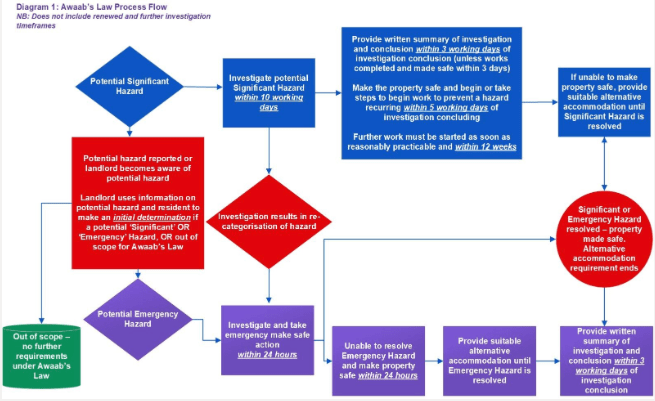
The Court agreed that, as a starting point, the works had not been completed within the statutory timeframe. But that leads onto the Defendant’s primary defence: a lack of access.
4. Access
The Defendant went through various allegations of no access, the significant majority of which were based on the Defendant’s attempts to complete the works after the injunction had been issued. Little attempt had been made prior to this date. The Defendant did not show, however, that it had substantially complied with Regulation 20 of the 2025 Regulations:
20.—(1) In a lease of a social home, there is implied a covenant by the lessee that the lessor, or a person authorised in writing by the lessor, may enter the social home for the purposes of complying with any requirement under these Regulations that is applicable in relation to the social home.
(2) The covenant implied by paragraph (1) requires entry to the social home to be permitted—
(a) only at reasonable times of the day, and
(b) only if at least 24 hours’ notice in writing has been given to the occupier of the dwelling.
Nor had they had regard to the guidance given in the Guidance for Social Landlords document:
Landlords should seek to obtain access to the property to investigate and/or complete relevant safety works as quickly as possible, and it is recommended that they keep clear records of their attempts.
Reasonable steps to gain access could include:
- Working with the tenant to arrange a suitable time to visit the property, offering a range of timeslots and considering the tenants’ needs (e.g. their working pattern, any accessibility requirements or adjustments);
- Making multiple attempts at various times of the day to contact tenants and using different routes if one fails (e.g. phone calls, emails or letters);
- Making best efforts to engage with tenants and provide information on why access is needed and what they can expect, in a way that meets their needs (e.g. providing translation services and accessible communications, or information about who will be attending to provide reassurance);
- Taking into account any issues or barriers to allowing access and working with the tenant to overcome them, including enabling a representative of the tenant such as a family member, friend or support worker to be present during a visit;
- If the social landlord is unable to access the property within the agreed timeslot, leaving the tenant a notice stating that an attempt was made and providing contact details to arrange an alternative slot.
Finally, going back to the Defendant’s witness statement that they ambushed me with, they had accused the Claimant of not allowing access on a particular date but had provided other documents showing that they had completed an inspection on that particular date. The Defendant’s allegations were contradictory, inaccurate, and wrong.
5. Standard injunction requirements
Finally, working through the requirements set out in American Cyanamid Co (No 1) v Ethicon Ltd [1975] UKHL 1:
1. Was there a serious question to be tried – yes, the Defendant’s breach of contract and the presence of both significant and emergency hazards.
2. Would damages be an adequate remedy – no.
3. Where does the balance of convenience lie? – In favour of enforcement and restoring the status quo i.e. the Defendant not being in breach of contract.
The Order
The Claimant will be decanted from her Property to suitable alternative accommodation. The Defendant is to have regard to paragraph 8 of the Guidance:
Where the social landlord must secure the provision of suitable alternative accommodation, they must take into account the needs of the household to be assess what is ‘suitable’. This could include:
- ensuring adequate space for the tenants, including the appropriate number of bedrooms given the tenants’ family make up;
- considering the location of the property, including distance from tenants’ workplaces or schools;
- considering disability or medical needs to ensure accommodation is accessible for tenants;
- ensuring that the accommodation does not have further hazards or won’t lead to further hazards;
- if the household has pets, considering accommodation that is pet-friendly or can accommodate animals;
- considering the length of stay, as accommodation that is suitable for a short period may not be suitable for a longer time. For example, if a family of four is provided accommodation for one night only whilst an emergency hazard is addressed in their home, a hotel may be suitable. If relevant safety work is estimated to take six weeks to complete, a hotel would not be suitable due to lack of space and facilities such as a kitchen to prepare meals.
The works are to be completed within 3 weeks following the decant.
In terms of costs, I invited the Court to order indemnity costs because of the way the Defendant had treated the Claimant. For example, the Claimant’s expert had recommended a decant from the Property and the Defendant’s position was not to accept this, but instead to fabricate their own gloss on this by responding: ‘But he didn’t recommend an urgent decant, did he?’ Or words to that effect. It was by any account a curious position to take.
Whilst the Court did not order indemnity costs, the Court only reduced the costs by £500.
Lessons and tips for Claimants
An injunction under the 2025 Regulations is a powerful tool in the right circumstances. However, evidentially, it is extremely important to show that the ‘significant’ or ‘emergency’ hazard threshold has been met. An opinion from the expert is obviously of great assistance with this, but also a detailed statement from the Claimant detailing the impact of the hazard is equally important.
The Claimant must let the Defendant in the Property to complete the works but is entitled to 24 hours’ notice of the same. Any and all allegations of no access should be addressed in the Claimant’s witness statement.
Lessons and tips for Defendants
Record keeping is often the Defendant’s downfall in disrepair cases generally. Defendants would do well to approach these cases with three words in mind: ‘show, don’t tell’. Show that you have given 24 hours’ notice. Show that you have made reasonable attempts. Show that you have considered any vulnerabilities in the Property etc.
Also, do not raise curious arguments that pregnant women should be sleeping on sofas. Remember that an objective and neutral Judge will be looking at this case. When I was in the Army, we had something called The Tabloid Test. The test is this: if a tabloid newspaper recorded what you said or how you behaved, would they publish it, and would you be happy with that?’
The Defendant’s behaviour in this case does not pass The Tabloid Test.
NB I have used Claimant and Defendant throughout. In reality, these were the ‘Applicant’ and ‘Respondent’ respectively.


Leave a Reply